If you’re thinking about selling a home in Maryland, you’ve probably been watching mortgage rates just as closely as buyers have.
And there’s a good reason for that.
Higher mortgage rates don’t just affect people who are buying a home. They can also influence how quickly your home sells, what buyers are willing to pay, and which homes buyers ultimately choose.
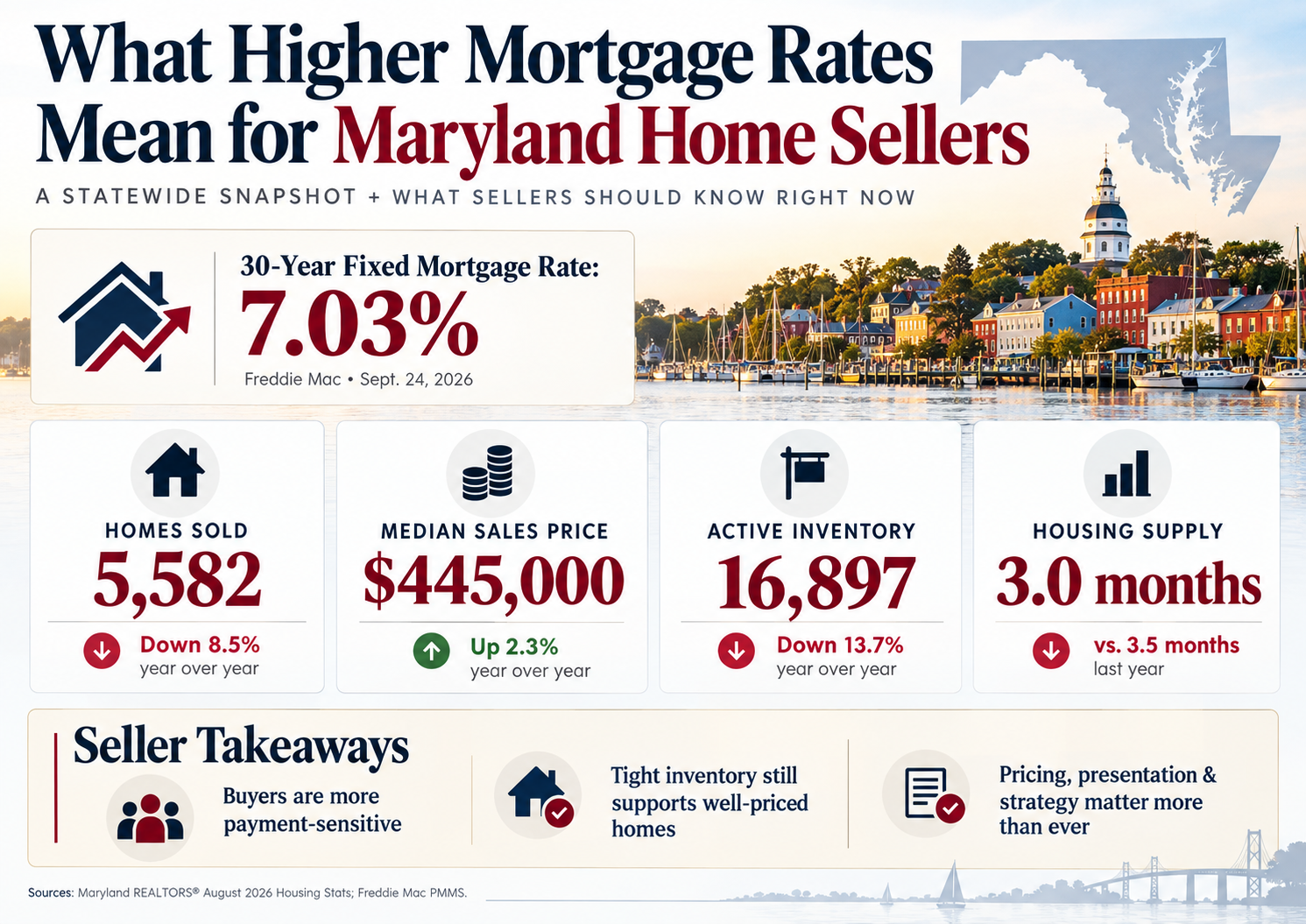
As mortgage rates have moved higher again, affordability has become an even bigger part of the conversation. According to Freddie Mac, the average 30-year fixed mortgage rate reached 7.03% in late September 2026, compared with 6.66% at the end of July.
For Maryland sellers, that doesn’t mean the market has suddenly turned against you. But it does mean your pricing and marketing strategy matter more than they did when buyers could borrow money at historically low rates.
Higher Rates Change What Buyers Can Afford
Most buyers don’t shop for a home based solely on the purchase price. They are looking closely at the monthly payment.
When mortgage rates increase, the payment on the same house increases as well.
For example, on a $500,000 mortgage, even a change of one percentage point in the interest rate can change the principal-and-interest payment by several hundred dollars per month.
That can cause buyers to:
-
Lower the price range they are considering
-
Become more selective about condition and upgrades
-
Negotiate harder
-
Ask for closing-cost assistance
-
Consider homes offering financing incentives
-
Compare resale homes more carefully against new construction
That last point is especially important in parts of Maryland where existing homes compete directly with new-home communities.
New Construction Is Competing for the Monthly Payment
Homebuilders have an advantage traditional homeowners usually don't have: they can use financing incentives as part of their sales strategy.
Some builders are offering buyers reduced mortgage rates, closing-cost assistance, upgrades, or other incentives designed to lower the buyer's effective monthly cost.
Keeping Current Matters points out that builders have increasingly used incentives—particularly mortgage-rate buydowns—to compete for buyers who are struggling with affordability.
That can create an interesting situation for a homeowner selling a resale property.
Imagine a buyer comparing a $600,000 resale home with a $625,000 new construction home. At first glance, the resale appears less expensive.
But if the builder is offering financing that substantially reduces the buyer's monthly payment, the more expensive new home may suddenly look competitive.
That means Maryland sellers can't evaluate their competition based on list price alone.
The Good News: Maryland Still Has Limited Inventory
While buyers are certainly more sensitive to mortgage rates, Maryland's housing market continues to have something working in sellers' favor: limited housing supply.
According to Maryland REALTORS®, only 5,582 homes sold statewide in August 2026, an 8.5% decline from the previous August. But the statewide median sales price still increased 2.3% to $445,000.
At the same time, active inventory was 13.7% lower than a year earlier, and Maryland had only about three months of housing inventory available.
That distinction matters.
Higher interest rates have reduced some buyer purchasing power, but Maryland has not experienced the dramatic inventory buildup seen in some other parts of the country.
There are still buyers looking for homes. The challenge is getting those buyers to choose your home.
Pricing Has Become More Important
One of the biggest mistakes a seller can make in this market is pricing a home based on what a neighbor sold for six or twelve months ago without considering today's competition.
A home's market value is determined by what today's buyers are willing and able to pay.
That means we need to look at:
-
Recent comparable sales
-
Homes currently competing with yours
-
Properties that went under contract recently
-
Price reductions in your neighborhood
-
Days on market
-
Buyer showing activity
-
New construction competition
-
Current mortgage rates
-
Seller concessions being offered by competing properties
I call this looking at the Real-Time Market Pulse.
Sold properties tell us where the market has been. Active listings and buyer activity give us clues about where the market is heading.
Both matter when determining the right listing price.
Should Maryland Sellers Offer a Mortgage Rate Buydown?
Possibly—but certainly not automatically.
A seller can sometimes contribute money toward a buyer's closing costs or mortgage-rate buydown, subject to the buyer's loan program and lender requirements.
But a rate buydown is only one tool.
Depending on the property and local market conditions, a seller may be better served by:
-
Adjusting the asking price
-
Providing a closing-cost credit
-
Making a specific repair
-
Offering an allowance for an outdated feature
-
Providing a home warranty
-
Improving the home's presentation
-
Addressing an objection before the property goes on the market
The important question isn't:
“Should every seller offer a rate buydown?”
The better question is:
“What will give this particular home the strongest competitive position while protecting the seller's bottom line?”
Those are two very different questions.
Price Reduction vs. Closing-Cost Assistance
This is another strategy sellers should understand.
Suppose a seller is considering a $10,000 price reduction.
Depending on the buyer's financing, that $10,000 reduction may result in only a relatively small reduction in the buyer's monthly mortgage payment.
In some situations, applying some or all of that money toward allowable closing costs or a mortgage-rate buydown could have a much greater impact on the buyer's immediate affordability.
That doesn't mean a seller credit is always the better choice. Sometimes the property simply needs a price correction.
But before automatically reducing the price, I believe sellers should understand how each option affects the buyer and the seller's net proceeds.
That's where an experienced real estate agent and knowledgeable mortgage professional can work together.
Your Home Has Advantages New Construction Can't Always Replicate
Competing with builders doesn't necessarily mean trying to copy their incentives.
Existing homes often have advantages new construction can't easily duplicate.
Depending on the property, those could include:
-
A larger or more established lot
-
Mature landscaping
-
Finished basements
-
Fences, decks, patios, sheds, or other improvements
-
Established neighborhoods
-
Walkability to schools, parks, shopping, or transportation
-
Shorter commute times
-
Immediate availability
-
Lower HOA or community fees
-
Locations where very little new construction is available
In areas like Odenton, Crofton, Gambrills, Bowie, Annapolis, Severna Park, Columbia, and other parts of Central Maryland, location and neighborhood amenities can be every bit as important as the house itself.
Those advantages need to be clearly communicated in your marketing.
Simply putting a home into the MLS and waiting for buyers to find it isn't enough.
Presentation Matters More When Buyers Are Payment-Conscious
When buyers are stretching their budgets, they often become less willing to spend additional money after settlement.
That makes condition and presentation more important.
A buyer may be willing to pay more for a home that feels move-in ready than for a less expensive property that immediately needs flooring, paint, appliances, landscaping, or other improvements.
Professional photography, video, floor plans, virtual tours, proper staging, accurate property information, and aggressive online exposure all become part of the pricing equation.
The goal is to make buyers see the value of the property, not simply its asking price.
Don't Try To Time Mortgage Rates
Sellers sometimes tell me:
“Maybe I'll wait until mortgage rates come down.”
That sounds logical, but there are two problems with that strategy.
First, nobody knows exactly when rates will decline or by how much.
Second, lower mortgage rates can bring more buyers into the market—but they may also encourage more homeowners to list their properties.
Today's limited inventory is part of what continues to support Maryland home prices.
Waiting for better rates could mean selling into a market with more buyers, but it could also mean competing against significantly more listings.
The better decision should be based on your circumstances, your property's value, the competition in your specific market, and what you plan to do after the sale—not solely on a prediction about interest rates.
What Maryland Sellers Should Take Away From Today's Market
Higher mortgage rates haven't eliminated buyer demand in Maryland. But they have changed buyer behavior.
Buyers are paying much closer attention to monthly payments and overall affordability. They are comparing homes carefully, and they have less tolerance for properties that appear overpriced.
At the same time, Maryland continues to have relatively limited housing inventory, which means properly positioned homes can still attract strong buyer interest.
For sellers, the formula is increasingly straightforward:
Price accurately. Prepare the home properly. Understand the competition. Market aggressively. And be strategic when negotiating.
A seller shouldn't automatically lower the price, offer thousands of dollars in concessions, or provide a mortgage-rate buydown simply because rates are higher.
Those decisions should be based on the actual data surrounding your property and your local market.
Thinking About Selling a Home in Maryland?
Every neighborhood is different.
The market for a home in Odenton can be very different from Crofton. Bowie can behave differently from Annapolis. And even two subdivisions within the same ZIP code can have different inventory levels, buyer demand, and pricing trends.
Before putting your home on the market, we can prepare a detailed analysis showing:
-
What your home may be worth today
-
Current competing listings
-
Recent sales
-
Local inventory levels
-
Buyer activity
-
How long comparable homes are taking to sell
-
Whether sellers are offering concessions
-
How your property compares with nearby new construction
-
The marketing and pricing strategy most likely to produce the strongest result
The objective isn't simply to put your home on the market.
It's to position it correctly from the beginning so you can make informed decisions and maximize the opportunity the current market provides.
Thinking about selling? Contact The Scott Smolen Team for a no-obligation analysis of your home's value and the current market conditions in your neighborhood.