By Caleb Leonard
Buying a home is a significant financial commitment and choosing between a new build and an older home deserves careful consideration. The sticker shock of a new build comes with the reassurance that maintenance woes are a few years away (hopefully), and the financial upkeep of older homes is sweetened by the location and character of established neighborhoods.
Choosing between buying a new construction and a resale property is less about which option is inherently better and more about defining your priorities, namely cost, condition, and location.
To begin, let's assess your priorities.
Defining Your Home Buying Priorities
- Cost: Do you have a limited upfront budget that makes immediate repairs a burden, or are you prepared to pay a higher initial price in exchange for future peace of mind?
- Time and Effort: Do you need to move in ASAP, or are you willing to wait 6 to 12 months for your dream home?
- Aesthetics and Function: Do you prefer a modern layout with advanced energy efficiency, or do you value the architectural character and mature trees that only older homes can offer?
Financial Considerations: Upfront Price vs. Long-Term Value
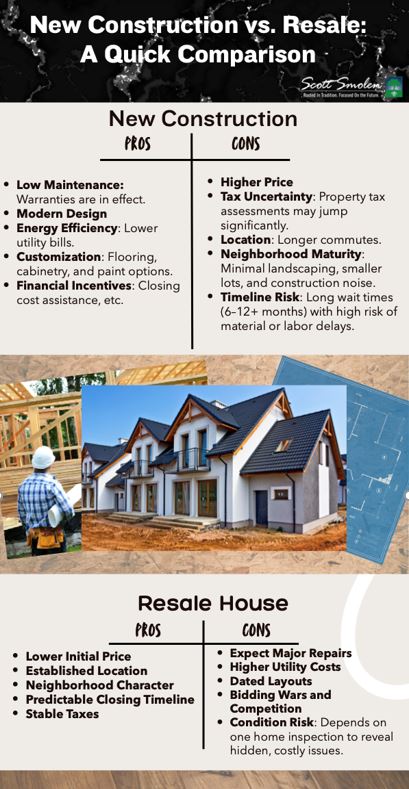
New homes are usually more expensive, and there is less room for negotiation. However, the builder or developer may offer incentives, such as assistance with closing costs or mortgage rate buy-downs.
The higher price of a new home buys you the peace of mind that everything is still under warranty and state-of-the-art.
The biggest gamble with buying a newly constructed home is the tax assessment since you won't know your development's worth until the county appraiser completes the final valuation of the entirely built property. Beware of significant increases in your annual property tax bill.
Resale homes often have a lower sticker price, and there's ample room for price negotiation. However, incentives typically rely on seller concessions.
Despite passing a home inspection, buyers of a resale home should expect to encounter some home repairs and budget accordingly.
Older homes typically have more stable or lower historical taxes.
Condition, Features, and Energy Efficiency
New homes offer open-concept floor plans, higher ceilings, smart home features, and the ability to select finishes, such as flooring, cabinetry, and paint colors, before moving in.
New builds let you further customize your dream home. A chef's kitchen with a ducted range hood? A shower with benches and a rainfall showerhead? These modern luxuries are more accessible in new homes.
New builds feature energy-efficient appliances, double-pane low-E windows, and superior insulation, resulting in lower energy bills.
Despite the polished appearance of a new build, it is essential to research the builder's reputation, double-check the construction phase inspections, and hire your own inspector.
Resale homes sometimes have dated floor plans, lower ceilings, and may require expensive, invasive remodeling to achieve modernization and personalization.
Older homes may have outdated technology, older appliances, and inadequate insulation. Owners of older homes will need to consider the cost of higher monthly utility bills vs. retrofitting the house to improve efficiency.
Timeline, Location, and Market Competition
Money and maintenance aside, homebuyers care about resale value, move-in timelines, and, of course, location, location, location. Oh, and never underestimate the allure of mature trees!
New homes often face construction delays, as well as labor and material shortages, which can push back your move-in date by several months. This uncertainty attracts less competition from buyers, resulting in fewer bidding wars.
Newer construction often occurs in developing areas, such as suburbs and exurbs, so commute times may be longer while amenities and infrastructure continue to evolve. Keep in mind that construction noise and delays will be a temporary way of life.
Resale homes are closer to the city center. Their proximity to offices, shopping centers, and schools makes them highly sought after, often leading to bidding wars. If you're looking to buy a resale home, you may need to pay above the asking price.
Unlike new homes, the closing timeline for resale homes is usually 30-60 days.
Neighborhood Maturity, Character, and Lot Size
If you've ever driven through the historic neighborhoods of your city, you can feel the heritage of homes that have been marinating in coexistence for decades. The trees embrace from across the street, and the lot sizes give you room to breathe.
Homebuyers seeking larger lots, architectural diversity, mature trees, and a sense of community should consider resale homes.
If you're not a fan of landscaping, a newer home with a smaller lot size may be a better fit for your lifestyle.
How to Make the Right Choice for You
Choosing between a new construction and a resale property is a personal decision that affects your finances and lifestyle. Examine your budget, move-in timeline, and priority checklist, taking into account cost, condition, and location.
Whether you're looking to buy a new or resale home, Scott and the Smolen Team will help you find what you are looking for!
Caleb Leonard is a freelance writer for HomeGnome.com and marketing professional. A graduate of the University of North Texas, his interests include gardening, podcasts, and studying Spanish.