Scott Smolen Maryland real estate blog with market updates, community spotlights, and home buying tips

Maryland Real Estate Blog

Scott Smolen's Anne Arundel County and Bowie, Md. Real Estate Blog

Local real estate updates, market insights, community spotlights, and practical home buying and selling advice for Odenton, Gambrills, Crofton, Bowie, Piney Orchard, Two Rivers, and the surrounding Maryland real estate market.

Latest Market Trends

Stay current on mortgage rates, local inventory shifts, pricing trends, and buyer demand across the Maryland real estate market.

Home Selling Advice

Learn how to prepare, price, market, and negotiate when selling a home in today’s local market.

Home Buying Tips

Get practical guidance on affordability, inspections, offers, financing, and buying with confidence.

Community Spotlights

Explore local neighborhoods, market reports, lifestyle features, and community insights throughout the area.

April 6, 2023

FICO Score: Understanding Its Importance When Applying for a Mortgage

When it comes to applying for a mortgage, your FICO score is one of the most important factors that lenders will consider. Your FICO score is a three-digit number that represents your creditworthiness, and it plays a significant role in determining whether you qualify for a mortgage and what interest rate you will be offered. In this blog post, we will explain what a FICO score is, how it is calculated, and why it is important when applying for a mortgage.

What is a FICO score?

A FICO score is a credit score developed by the Fair Isaac Corporation, which is the most widely used credit scoring model in the United States. FICO scores range from 300 to 850, and they are based on information from your credit report. Your credit report contains information about your credit history, including your payment history, the amount of debt you have, the length of your credit history, and the types of credit you have used.

How is a FICO score calculated?

FICO scores are calculated using a complex algorithm that considers various factors from your credit report. The most important factors that affect your FICO score are:

  • Payment history: Whether you've made your credit payments on time.
  • Amounts owed: The total amount of debt you have and how much of your available credit you are using.
  • Length of credit history: How long you have had credit accounts open and the age of your oldest credit account.
  • Credit mix: The different types of credit accounts you have, such as credit cards, loans, and mortgages.
  • New credit: How many new credit accounts you have opened recently and the number of inquiries on your credit report.

Why is a FICO score important when applying for a mortgage?

When you apply for a mortgage, lenders use your FICO score to determine your creditworthiness and your ability to repay the loan. A higher FICO score indicates that you are less of a credit risk, which can result in a lower interest rate and more favorable loan terms. Conversely, a lower FICO score can result in a higher interest rate and less favorable loan terms, or even the rejection of your mortgage application altogether.

In addition to determining your interest rate and loan terms, your FICO score may also affect the amount of money you can borrow. Lenders typically have minimum FICO score requirements, and if your score falls below that threshold, you may not be eligible for certain loan programs or may only be able to borrow a smaller amount of money.

How can I improve my FICO score?

Improving your FICO score can take time, but there are several steps you can take to help boost your score, including:

  • Making all of your credit payments on time
  • Keeping your credit card balances low
  • Limiting the number of new credit accounts you open
  • Regularly checking your credit report for errors and disputing any inaccuracies
  • Maintaining a long credit history by keeping old credit accounts open

When applying for a mortgage, your FICO score is an essential piece of the puzzle. It is important to be aware of how this all-important number can influence whether you qualify and on what terms - by keeping tabs on it and working to improve any shortcomings, you could get approved much easier with better conditions. 

It is best to get in touch with your loan officer early in the process if possible.  This way they are able to review your credit reports and find out if there are areas that you will be able to improve, or if there are some possible errors on your report that is adversely impacting your FICO score.  

You are also able to setup credit monitoring through the 3 major credit bureaus if you would like to.  ExperianEquifax, and TransUnion all offer these services if you would like to keep an eye on your credit yourself.  As always, please let us know if you have any questions at all and we will do our best to answer them for you.

 

Posted in
April 5, 2023

Is it Time to Sell Your Home? Consider the Market and Your Needs

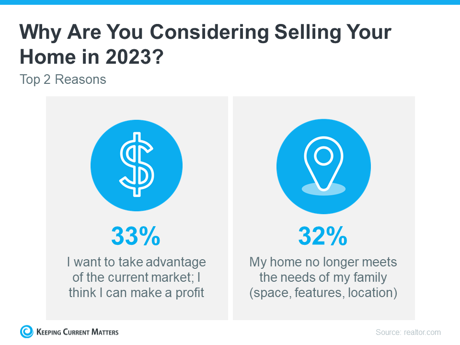
Contemplating whether to sell your home this year? As you ponder this decision, reflect on the factors driving your consideration to move. A recent survey from Realtor.com delved into why homeowners are contemplating selling their homes in the current year.

Let's analyze these reasons and explore how they may resonate with you.

1) Capitalizing on the Favorable Market and Garnering a Profit:

When selling your home, it's natural to consider the potential return on investment. The good news is that recent data indicates that the average seller can anticipate a substantial profit from their home sale. According to ATTOM,

"The $112,000 profit on median-priced home sales in 2022 represented a 51.4% return on investment compared to the original purchase price, up from 44.6% last year and from 32.8% in 2020."

Although home prices may have slightly decreased in certain markets, they remain considerably higher overall compared to just a few years ago. To understand the current status of home prices in your area and the current value of your home, it's best to reach out to us for some guidance so you are in the position to make an informed decision.  We are able to give you a an accurate idea of the the potential gains you could achieve if you decide to sell this year.

2) Your Home No Longer Meets Your Needs:

On average, individuals tend to stay in their homes for about ten years. However, a lot can change in your life during that time period. Life events, personal circumstances, or changing preferences may result in your current home no longer meeting your needs. Whether it's a need for more space, fewer responsibilities, different features, or a location closer to your work or loved ones, your current home may not align with what you envision as your ideal home. If that's the case, it may be worthwhile to collaborate with Scott and his team to find a better-suited home that meets your current needs.

In Conclusion:

If you're contemplating selling your home, there's likely a compelling reason driving your decision. Connecting with a local real estate advisor can help you make a well-informed decision and take steps towards achieving your goals this year. So, take the time to reflect on your motivations and seek professional guidance to make a sound decision regarding selling your home. The Scott Smolen Team can help you navigate the current housing market and put you in the best position to net as much as possible out of your sale if you decide to sell.

Let's make this year a successful one for you! So, go ahead and take the first step towards your home selling journey and get an idea of what your home is worth here.

Posted in
April 4, 2023

Title Insurance - Standard vs. Enhanced Policy: Understanding the Differences

Home ownership is a significant milestone and the largest financial investment many people will ever make. To safeguard their rights to that property, title insurance can be an invaluable addition - protecting owners from costly fees if any challenges arise regarding legal ownership of their home.  We posted a blog about title insurance and why it's important last week.  We did have some specific questions about it the information.  Based on that feedback, we felt it would be best to explain some of the differences between an Owner's title insurance standard policy and an enhanced policy below.  

Owner's title insurance is not mandatory but worthwhile in my opinion.  It provides assurance against future claims or disputes regarding one's right of possession over the property purchased. Bearing in mind lender requires you purchase lender's title insurance on their behalf, so the lenders consider title insurance essential.  As a Buyer you should consider two types of policies: Standard and Enhanced Title Insurance options - both providing crucial protection at different levels.  Both are optional and the standard policy is less expensive than an enhanced policy.  Your title company will be able to give you a price quote and the specific coverages for both policies, so that you are able to make an informed decision.  

Standard Policy:

A Standard Owner's title insurance serves as an essential layer of protection for homeowners and lenders. This includes protection against:

  • The inability to transfer ownership
  • Any lien, encumbrance, or defect on the title
  • Removal of existing structures due to an encroachment onto an easement, a building set-back line or even onto an easement on your neighbor’s land
  • The lack of right of access to and from your land

Enhanced Policy:

An Enhanced Owner’s title insurance policy includes all the coverages listed above with the Standard Policy, plus protection against other risks such as:

  • Someone is trying to impose an unjust limitation on your real estate title, rooted in discrimination against race, color, religion, sex, and other protected qualities
  • Your title is taken or lost because of a violation of a restriction or covenant that occurred before you acquired the title
  • One of your neighbors builds a building or structure after the policy date that encroaches onto your land
  • There is a lack of pedestrian or vehicular access to and from your land, based on a legal right.  This would make your property known as being "landlocked" and drastically reduce its value.
  • A taxing authority may impose additional taxes on real estate that has been modified, changed ownership, or had a shift in its purpose prior to the policy date

When it comes to purchasing a property, even the most experienced title professionals may fail to identify some of its risks and potential problems. Fortunately, beyond their thorough search process, they also offer an owner's policy of title insurance that shields you from unforeseen issues such as filing errors or undisclosed heirs - so essentially protecting your ownership rights for life. 

Please feel free to leave a comment or send us a message if you have any specific questions at all.  We will be happy to answer the best we can for you.

Posted in
April 3, 2023

Learn the Truth About the Capital Gain Tax Exclusion on the Sale of Your Principal Residence

Do I need to re-invest all of the proceeds from the sale of my principal residence to avoid paying capital gains taxes?

I have been getting this question more lately.  There seems to be a misunderstanding among some Sellers that in order to avoid paying capital gains tax, the profits of the sale of their primary home need to be immediately re-invested into another home.  This was the case prior to the tax law changing in 1997.  This is still the case when investors sell rental properties and use a 1031 Tax Deferred Exchange to defer capital gains taxes. 

In general, when you sell your principal home, you may be able to exclude some or all of the capital gains from your taxable income. The amount you can exclude depends on a few factors, including how long you have owned and lived in the home, and how much profit you make from the sale. 

How you choose to spend or save the proceeds from the sale of your principal residence does not have an impact on your capital gain tax exposure.  If you chose to re-invest some or all of the proceeds in your next home is a decision that is solely up to you to make.  

Under current U.S. tax laws, if you have owned and used the home as your main residence for at least two out of the five years before the sale, you can exclude up to $250,000 of capital gains if you are a single filer, or up to $500,000 if you are a married couple filing jointly. If you meet these requirements and the profit from the sale of your home is below these amounts, you may not have to pay any capital gains taxes. However, if you do not meet these requirements, or if the profit from the sale exceeds the allowed exclusion amount, you may need to pay capital gains taxes. The amount of tax you owe will depend on your income level and the length of time you owned the home.

The current law regarding the capital gains tax exclusion for the sale of a primary residence was established in 1997 under the Taxpayer Relief Act. This law allows taxpayers to exclude up to $250,000 of capital gains from the sale of their primary residence if they have owned and lived in the home for at least two out of the five years preceding the sale. In 2003, the law was modified by the Jobs and Growth Tax Relief Reconciliation Act. The modification increased the capital gains tax exclusion to $500,000 for married couples filing jointly. Since the law was established in 1997, there have been no other significant changes to the capital gains tax exclusion for the sale of a primary residence.

It's important to note that tax laws can change over time, so it's always a good idea to consult with a tax professional or financial advisor to ensure that you are up-to-date on the latest tax laws and how they may impact your situation.

Posted in
April 2, 2023

The Fort Meade Area Housing Market Continues to Stay Hot: National Trends and Local Data

The Fort Meade Area Housing Market Continues to Stay Hot

The real estate market is very local in nature.  It varies from city to city, county to county and state to state.  The market condition also varies with home type and price point.  However these national trends and data do provide some insight from a 40,000 foot view of the overall market conditions.  It is not surprising that many of the markets that went up quickly in price are also the areas that are beginning to see some price declines as well as activity declines.  These are tending to be out West and some areas in the South. 

Our real estate market in the Fort Meade area continues to be very hot due to the lack of available home inventory and the solid Washington DC area job conditions.  We are recommending that Sellers who have been waiting for the later part of the "Spring Market" move forward sooner rather than later if possible while the available home inventory is still relatively low.

Leading Indicators of National Homebuying Activity:

  • For the week ending March 30, average 30-year fixed mortgage rates dropped to 6.32%, the third straight week of declines.
  • The daily average was 6.59% on March 30.
  • Mortgage-purchase applications during the week ending March 24 increased 2% from a week earlier, seasonally adjusted, marking the fourth straight week of increases.
  • Purchase applications were up 19% from a month earlier, but down 35% from a year earlier.
  • Google searches for “homes for sale” were up about 44% from the trough they hit in December during the week ending March 25, but down about 17% from a year earlier.
  • Touring activity as of March 26 was up about 20% from the start of the year, compared with a 24% increase at the same time last year, according to showing service company that logs tours for the majority of Realtors, ShowingTime.
  • The median asking price of newly listed homes was $392,225, up 1.4% year over year.
  • The monthly mortgage payment on the median-asking-price home was $2,518 at a 6.32% mortgage rate, the current weekly average. Monthly mortgage payments are down slightly from the peak they reached three weeks ago, but up 16% ($354) from a year ago.
  • Pending home sales were down 19.2% year over year, the biggest decline in nearly two months.
  • Pending home sales fell in all 50 of the most populous U.S. metros.
  • Active listings (the number of homes listed for sale at any point during the period) were up 13.9% from a year earlier, the smallest increase in more than four months.
  • Months of supply—a measure of the balance between supply and demand, calculated by the number of months it would take for the current inventory to sell at the current sales pace—was 2.8 months, down from 3.5 months a month earlier and up from 1.9 months a year earlier. On average, 4.9% of homes for sale each week had a price drop, up from 2.2% a year earlier.
  • The average sale-to-list price ratio, which measures how close homes are selling to their final asking prices, was 98.6%, the highest level in four months but down from 101.7% a year earlier.

A Closer Look at the Data for Some Cities Around Fort Meade

Monthly Housing Data and Statistics for Odenton

Monthly Housing Data and Statistics for Gambrills

Monthly Housing Data and Statistics for Crofton

Monthly Housing Data and Statistics for Annapolis

Monthly Housing Data and Statistics for Bowie


Posted in
April 1, 2023

Selling a Home with a Reverse Mortgage: Understanding the Unique Requirements

Selling a home with a reverse mortgage

In 1988, President Reagan changed the game for senior homeowners in America with a revolutionary new law. The Home Equity Conversion Mortgage (HECM) offered seniors access to their home equity without having to move out of their residence - something unheard of before then. Before this law was passed, many faced "house-rich and cash-poor" situations when desperate times called for extra funds... but no longer is that an issue thanks to HECM's. This important legislation brought relief from financial struggles which have only become more difficult during these tougher economic times.

Reverse mortgages have become increasingly popular since their inception, and as of 2016 more than a million are outstanding. If you are selling your home (or possibly a family member's home) with this financial tool in place, the listing process is essentially like any other residential property sale - but there are some unique features involved that require special attention! Understanding these requirements can help ensure for an easy navigated transaction.

What is a Reverse Mortgage?

Are you over the age of 62 and own your residence? You might qualify for a reverse mortgage! This type of loan allows seniors to secure financing based on their home's equity. To be eligible, homeowners must have either paid off all debt associated with their property or possess enough equity in it so that the loan would cover any outstanding payments. Plus, they need to live in the house at time of application.

There are other requirements to secure an FHA HECM loan, including receiving counseling, but the three listed above are necessary to get to the next step in the process. An increasing number of seniors are now meeting these requirements and are using reverse mortgages as a part of their retirement planning.

Provisions and Disadvantages of a Reverse Mortgage

Selling a home with reverse mortgage complications can be challenging - however, there are scenarios that many seniors may encounter. These include relocating to an assisted living facility, family members helping during difficult times, and passing down the inheritance after loss of life. Additionally, financial issues like inability to pay taxes or mortgages could arise for senior citizens and their heirs alike, leaving them vulnerable in foreclosure without proper preparation/action.

When selling a home with a reverse mortgage, it is important to keep key deadlines in mind. Remember that if the senior no longer lives there, then their loan must be paid off promptly - do not miss those dates. If someone other than the living owner is negotiating on behalf of one or more seniors (like an Administrator or Trustee), make sure they have valid documentation confirming this authority before you move forward. This process can feel complex at times; following these steps will help ensure everything runs smoothly for all involved.

Ensuring You Follow the Correct Steps

When a property owner passes away or moves from their home, it's important to understand the implications of this default event on the sale process. The mortgage company is likely to send out what is called a demand letter; meanwhile, all parties involved in selling should realize that those responsible for handling and satisfying the loan are not necessarily its originators. This means they will be impacted by any agreements made with regards to said sales--which must consider when exactly these scenarios occurred (i.e., date of death/moving). From there on out, note that timelines associated with Home Equity Conversion Mortgages (HECM) revolve around said date.

Reverse mortgages are an important loan option for many people, and the legalities associated with them should be taken seriously. Upon certain events such as death or if a borrower moves out of their home lasting more than 12 months, all outstanding reverse mortgage loans must be paid within six months due to defaulting on payment. A 30-day notice will then follow from the servicing company in charge of handling the property’s specific loan details - this is unlike normal defaults where payments have failed to meet requirements. Finally, obtaining approval by way FHA appraisal at least 6 months after receiving notification is essential for streamlining any process connected to your reverse mortgage needs.

Matching your needs to the FHA Timelines

Taking proactive steps when dealing with a reverse mortgage can help you make the most of your options. For instance, speaking to a Realtor early on will enable more tailored planning for events like moving into nursing care (which this event and like events can start the 6-month clock!)- where proceedings from sale could be used as financing in this case if necessary. This step may also include getting comparative valuations before an appraisal is requested; doing so gives valuable insight without initiating the 12-day waiting period and any further appraisals down the line. In default situations such as death or relocation, servicers are obligated by law to order an appraisal within 30 days’ time.

What to do if the deadline is not met?

If time constraints are looming for a real estate transaction, do not panic! There's hope yet -- it may be possible to apply for an extension of up 90 days. Simply follow the necessary steps and provide evidence that you require extra time, and the application could give you some breathing space before closing.

Dealing with defaults

Homeowners must stay on top of property taxes and reverse mortgage payments to avoid default, foreclosure, or other undesirable situations. If you are struggling financially with keeping up the payments current, a Realtor can provide valuable advice for how best to protect your home from any future consequences.

As you cope with the emotional effects of a parent or loved one’s incapacitation or death, it can be difficult to take action on any property they may have left behind. However, if that house was financed using an FHA HECM reverse mortgage, taking responsibility, and getting informed is essential for having peace-of-mind during the process of selling your inherited home. Start by connecting with a Realtor - they will provide guidance and knowledge throughout your journey.

Working with Scott

We have dealt with a plethora of sales involving reverse mortgages over the past 24 years.  If you are in the position where you or a family member has a home with a reverse mortgage that you need to sell, please feel free to reach out to us (even if the home is not in an area we personally service).  We can provide you with some specific guidance and put you in touch with the right Realtor for the job if the house is located outside of our personal service area. 

Selling a home with a reverse mortgage is a bit more complicated than a regular home sale, however if everything is planned well and executed correctly then it should go smoothly.  It is imperative to have a knowledgeable and dependable team working on your behalf during the sale.


Posted in
March 31, 2023

Title Insurance: What It Covers and Why It's Important

Buying a home is exciting and it can be a little overwhelming. As you make your way through the process, it's important to consider one of the most critical aspects: title insurance. Title insurance safeguards homeowners from unexpected financial losses relating to property titles with potentially hidden title defects - making sure their first step on the path to that dream house means they reach it safe, secure, and ready for years of happy memories ahead! In this blog post we will explain exactly what title insurance covers so all future homeowners can rest easy when signing those dotted lines.

What is Title Insurance?

Title insurance is a policy that protects the homeowner from financial losses due to defects in the title of the property. A title defect is any issue that affects the ownership of the property, such as:

  • Errors in public records
  • Liens or judgments against the property
  • Undisclosed heirs or missing heirs
  • Fraudulent or forged documents
  • Easements or rights of way that affect the property

If a title defect is discovered after the purchase of a home, it can lead to legal disputes, financial losses, and even the loss of the property. Title insurance provides protection against these risks.

Why is Title Insurance Important?

Title insurance is important because it provides protection against financial losses due to defects in the title of the property. When purchasing a home, the buyer expects to receive clear ownership of the property. However, title defects can occur that affect the ownership of the property, even if the seller has provided all necessary documents and information.

Title insurance provides peace of mind for the homeowner, knowing that they are protected from financial losses due to title defects. In the event of a title defect, the title insurance policy will pay for legal fees and other expenses incurred in resolving the issue. This can save the homeowner thousands of dollars in legal fees and other costs.

Types of Title Insurance

There are two types of title insurance: owner's title insurance and lender's title insurance.

Owner's title insurance is purchased by the homebuyer and protects them from financial losses due to defects in the title of the property. It lasts as long as the homeowner owns the property.  This policy comes in handy if you decide to refinance your loan in the future.  You can use your current policy to get a "re-issue" rate when you refinance, which will save you money in closing costs at that time.  There are two basic owner's title insurance options, standard or enhanced owner's title insurance.

Lender's title insurance is purchased by the Buyer and protects the lender from financial losses due to defects in the title of the property. It lasts until the mortgage is paid off.  The lender requires you to purchase lender's title insurance at the time of closing.  However the lender's title insurance is in place to protect the lender's interest in the property, it is not there to protect you as the homeowner.  

While lender's title insurance is required by most mortgage lenders, owner's title insurance is optional. However, it's important for homeowners to consider purchasing owner's title insurance to protect themselves from financial losses due to title defects.  Title insurance is a one time cost at settlement.  You do not have any ongoing premiums after closing in order to maintain your coverage.  

When buying a home, title insurance is essential in safeguarding against potential financial losses. Homeowners can feel secure knowing that regardless of any existing issues with the property's legal documentation they are covered by an owner's investment - potentially saving them hundreds or even thousands of dollars! So to make sure you're protected in your new venture as a homeowner, don't forget about getting yourself this important protection.

During my nearly 25 years in the real estate profession it is rare that there has been a title insurance claim, however they do happen from time to time.  There was a period of one month in which we had 3 Sellers who all had title insurance claims for totally different reasons.  All 3 of their transactions would have been in major jeopardy.  Fortunately all 3 Sellers had purchased owner's title insurance when they bought their homes, so they were able to file a claim with their title insurance company and proceed to settlement without any delays or out of pocket costs.  Each claim was ultimately settled by the title insurance company, so the new Buyers will not have to worry about those particular issues coming up again in the future. 

I personally have purchased owner's title insurance for every home I have ever bought for myself.  I have never had to file a claim, but I felt the additional cost for peace of mind was worth paying.  It is a personal decision that each Buyer needs to make for themselves when it comes to owner's title insurance, however your lender will require lender's title insurance no matter what.  The exact cost of the policies will be shown on your Good Faith Estimate of closing costs, so there will not be any surprises as to what you can expect and you will be able to make an informed decision.  

Posted in
March 30, 2023

10 Common Home Inspection Findings and What to Expect

A home inspection is a big step in the home buying process, as it can identify potential issues that may impact the value of the property or pose a safety risk to the occupants. While every home inspection is unique, there are some common findings that tend to come up more frequently than others.

In this blog post, we will discuss 10 of the most common home inspection findings.  This is simply a general idea of items we see more often than other things.  Although the majority of homes are occupied or have been occupied until being sold, it is not uncommon for the Sellers to be unaware of many of these items.  Most Sellers are not crawling in their attics, or looking under sinks for possible slow leaks on a regular basis.  That is why the licensed home inspectors usually take several hours when they inspect a home.  

1. Roofing Issues

The roof is one of the most important components of a home, as it protects the interior from the elements. Common roofing issues that may be identified during a home inspection include missing or damaged shingles, leaks, and signs of general wear and tear.  If the roof is not actively leaking, or at the end of its expected life then it is important for the Buyer to be aware of the roof's condition as they can budget for a replacement down the road and are not blindsided with an unexpected expense.  If there are active leaks, then this is a reasonable request that Buyers often make for the Seller to repair provided the house is not being sold "as-is".

2. Electrical Problems

Electrical issues can be particularly dangerous, as they may pose a fire hazard. Common electrical issues that may be identified during a home inspection include outdated wiring, overloaded circuits, and improper grounding.  If these issues come up, then we can have a discussion at that time as to the best way to address them and proceed accordingly.  

3. Plumbing Deficiencies

Plumbing problems can cause significant damage to a home and may be expensive to repair. Common plumbing issues that may be identified during a home inspection include leaky pipes, clogged drains, and inadequate water pressure.  This is another issue that is case-by-case and can be dealt with as such.

4. HVAC System Malfunctions

A home's heating, ventilation, and air conditioning (HVAC) system is responsible for maintaining a comfortable indoor temperature. Common HVAC issues that may be identified during a home inspection include malfunctioning thermostats, dirty air filters, and issues with proper temperature differential.  These are all issues that can usually be resolved without too much difficulty.  

5. Insulation and Ventilation Problems

Proper insulation and ventilation are important for maintaining a comfortable and healthy living environment. Common insulation and ventilation issues that may be identified during a home inspection include inadequate attic insulation, insufficient ventilation in bathrooms and kitchens, and improper ventilation of the attic and crawl spaces.

6. Structural Deficiencies

A home's structure provides the framework for the entire property, so any issues in this area should be taken seriously. Structural deficiencies identified during a home inspection include cracks in the foundation, uneven floors, and damage to load-bearing walls.  Some of these deficiencies are minor in nature, while others can be more complicated.  

7. Water Damage

Water damage can be a sign of a more significant issue, such as a leaky roof or plumbing problem. Common signs of water damage that may be identified during a home inspection include water stains on walls or ceilings, and dampness in basements or crawl spaces.

8. Wood Destroying Insect Infestations

Wood destroying insect infestations can cause significant damage to a home if left untreated.  Common pests that may be identified during a home inspection include termites and carpenter bees.  

9. Safety Hazards

A home inspection will also check for safety hazards that may pose a risk to the occupants. Common safety hazards that may be identified during a home inspection include exposed electrical wiring, outdated or missing smoke detectors, and missing safety railings.  

10. Environmental Concerns

Finally, a home inspection may also identify environmental concerns that may impact the health of the occupants or the value of the property. Common environmental concerns that may be identified during a home inspection include lead-based paint, mold, and radon. In conclusion, a home inspection is a critical step in the home buying process. While every home inspection is unique, the 10 common findings discussed in this post can help you understand what to expect and prepare you to make informed decisions about your purchase. By identifying these issues early on, you can work with your Realtor to make the most informed decision possible about your purchase.  

This link will provide you with more information about the Home Buying Process with Scott.

Posted in
March 29, 2023

Tips for Selling Your Home During a Divorce

I know from first hand experience that selling your home during a divorce can be a difficult and stressful process. However, it is possible to sell your home successfully and make the best of a tough situation. With the right planning and support, you can get through this challenging time. Keep reading for some tips on selling your home during a divorce.

The first step to selling your home during a divorce is to hire a real estate agent who understands the process.  This can often begin with a simple consultation to determine the market value and your equity position.  There are times when one of the two partners is willing and able to purchase the other partner out of the house and selling is not the option that is needed.  In order to know if that is even possible, it is best to get a market analysis and see where you stand with the numbers then take that information under advisement.  

If it is determined that the best course of action is to sell the house, then the next step is choosing the Realtor to represent you in the sale of the house.  An experienced agent will help you prepare the house for the market, navigate the paperwork, negotiate an acceptable sale price, and get your house sold as quickly as possible for the top value. It's important to choose an agent who is knowledgeable about local market trends and pricing, so don't be afraid to ask questions or look for referrals before hiring your Realtor.  It is also very important that both partners agree on who they plan to work with unless there is a court order involved.  When both parties are comfortable with their Realtor, it will make the process work smoother.  Availability and open communication with the chosen Realtor are essential in a divorce sale.  

It is not uncommon for one of the two partners to have already moved from the house.  This is why an open line of communication is essential to keep everyone on the same page when it comes to the house component of the divorce.  We prefer to use group texts and group emails as much as possible to maintain transparency and an easy record of information for all parties involved and avoid getting signals crossed.  We also use conference calls as well when that method of communication is preferred by our Sellers.  There are times when private communication is needed as well.  It obviously will depend on the particular circumstances of the situation on a case-by-case basis.      

Next, consider whether you want to talk directly with your spouse about the sale of your home. Depending on the level of animosity between you and your spouse, it may be best to communicate through a third party such as a lawyer or mediator. If direct communication is necessary, make sure to stay professional and courteous.  Selling your home can be an emotional experience even in the best of times. 

Selling in the midst of a divorce tends to increase the stress levels for everyone (especially children) if they are involved.  Children are very adaptable in general, but it is imperative to keep in mind that this is a life change they very likely do not want on any level and they likely will have elevated anxiety.  I know that my children did not want to see their parents get a divorce, let alone see them moving from our family home.  It was extremely difficult on them, so the less stress that they had to face the better.  

When it comes to dividing the proceeds from your home sale, you should take time to consider all of your options. This will depend on individual circumstances, make sure that you consult an attorney who can help explain and establish your rights in the matter.  The title company handling the settlement can direct the proceeds based on a mutual agreement, or by court order if need be.  We often see Sellers divide the proceeds and simply get separate checks or wires at settlement.  

Finally, be prepared for the emotional toll that selling your home during a divorce can take. It's important to stay focused on the task at hand. It's best to lean on friends and family during this difficult time, and don't be afraid to reach out for help if you need it. With the right planning and support, you will get through this challenging time.  In time, things will improve.  However there usually are some bumps in the road along the way.  We work hard to minimize these issues when they arrive, so you are able to have the smoothest possible experience and turn the page to the next chapter in your life.  The process will be a one day at a time experience, however we are able to help layout the best plan to get you where you need to go with as little resistance along the way as possible.    

Please feel free to let us know if you have any questions at all and we will be happy to do anything we can to help. 


March 28, 2023

Home Tech Upgrades with the Highest ROI

Are your current home tech solutions a bit outdated? Do you want to upgrade but feel hesitant due to the potential costs and investments involved?

If you are looking for home tech upgrades that give the highest return on investment, look no further - we’ve got all the information you need right here! From clever lighting to advanced climate control systems, this blog post will provide homeowners with 10 of the best home tech investments they can make. Read on to learn about how these innovative solutions can help make your life easier (and save money in the long run!)

By investing in smart technology now, you'll thank yourself later as it pays dividends when it comes time to sell. Check out this video to learn more about the following upgrades.

1. Appliances

2. Thermostat

3. Window Treatments

4. Lighting

5. Home Security

6. Smoke Alarm

7. Water Sensors

8. Sprinkler System

9. Entertainment System

10. Smart-home Hub


Posted in