The Federal Reserve policymakers approved a 25 basis point rate hike to a target range of 4.75 percent to 5 percent in their campaign to combat inflation. The Fed also announced that it will continue to reduce support for mortgage markets during the pandemic by letting $35 billion in mortgage-backed securities and $60 billion in Treasuries roll off its balance sheet each month as part of its "quantitative tightening" plan.
While some had doubts about the Fed's rate-hike campaign after the failures of Silicon Valley Bank and Signature Bank, policymakers sent a signal that they believe the banking crisis has been contained and they remain committed to controlling inflation. However, Federal Reserve Chair Jerome Powell expressed caution, stating that events in the banking system may result in tighter credit conditions and that it is too soon to determine how monetary policy should respond.
Chief economist for the Mortgage Bankers Association, Mike Fratantoni, described the Fed's latest move as a "dovish hike" and predicted that mortgage rates will trend down this year, which will provide support for the purchase market. The MBA's weekly survey of lenders indicates that homebuyer demand for purchase loans increased for the third week in a row as mortgage rates eased, and the wide spread between 10-year Treasury yields and 30-year fixed-rate mortgages suggests that mortgage rates could come down further if bond yields stabilize.
There is a tried and true saying in the real estate business. You marry the house and date the mortgage rate. If you are considering buying a home and plan to be there for at least the next 3 years, it is likely a very good time for you to buy. As rates come down, then you can refinance your home to a lower mortgage rate when that happens. If you are only going to be in your next home 3 years or less, then you might be best served by renting. However rents have gone up and continue to go up steadily, so keep that in mind as you plan.
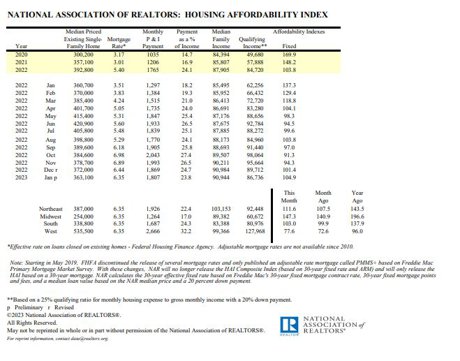
The higher rates in today's market are still historically low. However since home prices have appreciated quickly the home affordability index is not as low as it once was. If you take a look at the chart below, you will see that the home affordability index peaked in October of 2022 when mortgage payments were averaging 27.4% of a home's income. They have dropped since then and are coming in at 23.8% in January 2023. Although 23.8% is better, compared back to 2020, it is much higher than 14.7%. These numbers are important since the factor impacting the higher percentage the most is the mortgage rate. Back in 2020, the average was 3.17% compared to 6.35% in January 2023.
If you buy a home where you are comfortable with the payment at rate in the low 6's, then you will be much more comfortable when you are able to refinance at a lower mortgage in the future as the economists are predicting. The majority of those who bought back in 2020 during a period of uncertainty due to Covid made very good investments.
The Largest Part of Most Homeowners’ Net Worth Is Their Equity - You may be surprised to learn just how much of a homeowner’s net worth actually comes from owning their home. The National Association of Realtors (NAR) shares: “Homeownership is the largest source of wealth among families, with the median value of a primary residence worth about ten times the median value of financial assets held by families. Housing wealth (home equity or net worth) gains are built up through price appreciation and by paying off the mortgage.”
This is a good time to explore ARM's and fixed rate buydowns as options to buy. There are good mortgage options available if you are in the market to plant some roots and enjoy all of the benefits of home ownership. This is a bumpy market and there are a lot of moving parts. If you would like to discuss your options, please feel free to reach out to us and we will be happy to talk.