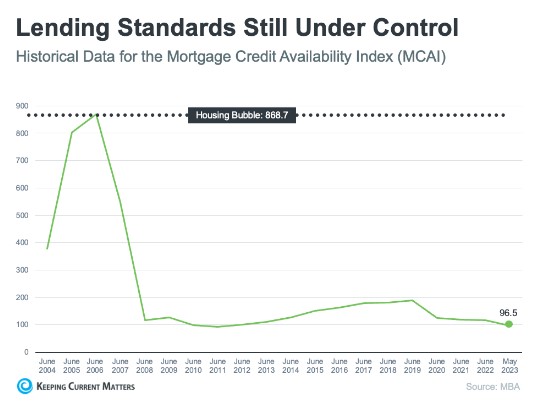
Don't worry about a housing crash, this market is different from 2008. One major reason is the change in lending standards. Let's look at the data to see why. The Mortgage Bankers Association (MBA) releases the Mortgage Credit Availability Index (MCAI) every month. According to them, this index is the most reliable measure of mortgage credit availability. It shows how easy or difficult it is to get a mortgage.
When lending standards are less stringent, it's easier to secure a mortgage, resulting in a higher index value (shown by the green line on the graph). On the other hand, stricter lending standards make it harder to get a mortgage, resulting in a lower index value. This data proves that lending standards today are different from what they were in 2008.
In just two years, from 2004 to 2006, the index skyrocketed from 400 to over 850. However, the landscape has changed drastically since then. Tighter lending standards after the crash have caused the index to decline, making it more difficult to obtain a mortgage in today's market.
Easy Mortgages and Risky Borrowers: The Causes of the Housing Bubble
During the early 2000s, getting a home mortgage was a breeze. Lending standards were lax, allowing many individuals to secure loans even if they lied about their income or couldn't afford homeownership. The result? A housing bubble. This graph clearly shows the peak leading up to the housing crisis, indicating the relaxed nature of credit availability and low requirements for loan approval. Lenders were handing out loans without thoroughly verifying if borrowers could repay them. This led to a higher risk of borrowers defaulting on their loans.
The Current Stringency of Loan Approvals in Comparison to the Past
Getting a loan today is not as easy as it used to be. Lending standards have changed significantly, with banks imposing strict requirements on borrowers. In fact, most people who are approved for a mortgage now have excellent credit. If we look at a graph illustrating these changes, it's clear that lending standards have dropped significantly since the housing crash. The current standards are even lower than what they were in 2004, and they're continuing to decline.
Joel Kan, the Vice President and Deputy Chief Economist at MBA, reports that mortgage credit availability has decreased for the third consecutive month, reaching its lowest level since January 2013. These decreasing standards indicate a much tougher lending environment, showing that we are taking steps away from the risky lending practices that led to the crash.
Final Takeaway
During the housing crash, lending standards were lenient and little effort was made to assess a borrower's ability to repay their loan. However, the current housing market has stricter standards, benefiting both lenders and borrowers by reducing risk. It is crucial to recognize that today's market is distinct from the previous one.