If you’re thinking about moving but already own a home, one of the first questions you’re likely to face is:
Should I sell my current home first, or buy my next home before I sell?
It’s an important decision because the order you choose can affect your finances, your negotiating position, and how stressful the entire move becomes.
There isn’t one answer that works for every homeowner. Your available cash, home equity, financing options, timeline, and the local real estate market all play a role.
For many homeowners in Anne Arundel County and the surrounding Maryland area, however, selling first can provide a much clearer path forward.
Why Selling Your Current Home First Can Make Sense
Trying to coordinate two real estate transactions at once can get complicated quickly.
Selling first removes one of the biggest unknowns from the equation: exactly when your current home will sell and how much money you’ll have available afterward.
That can make it easier to plan your next purchase with more confidence.
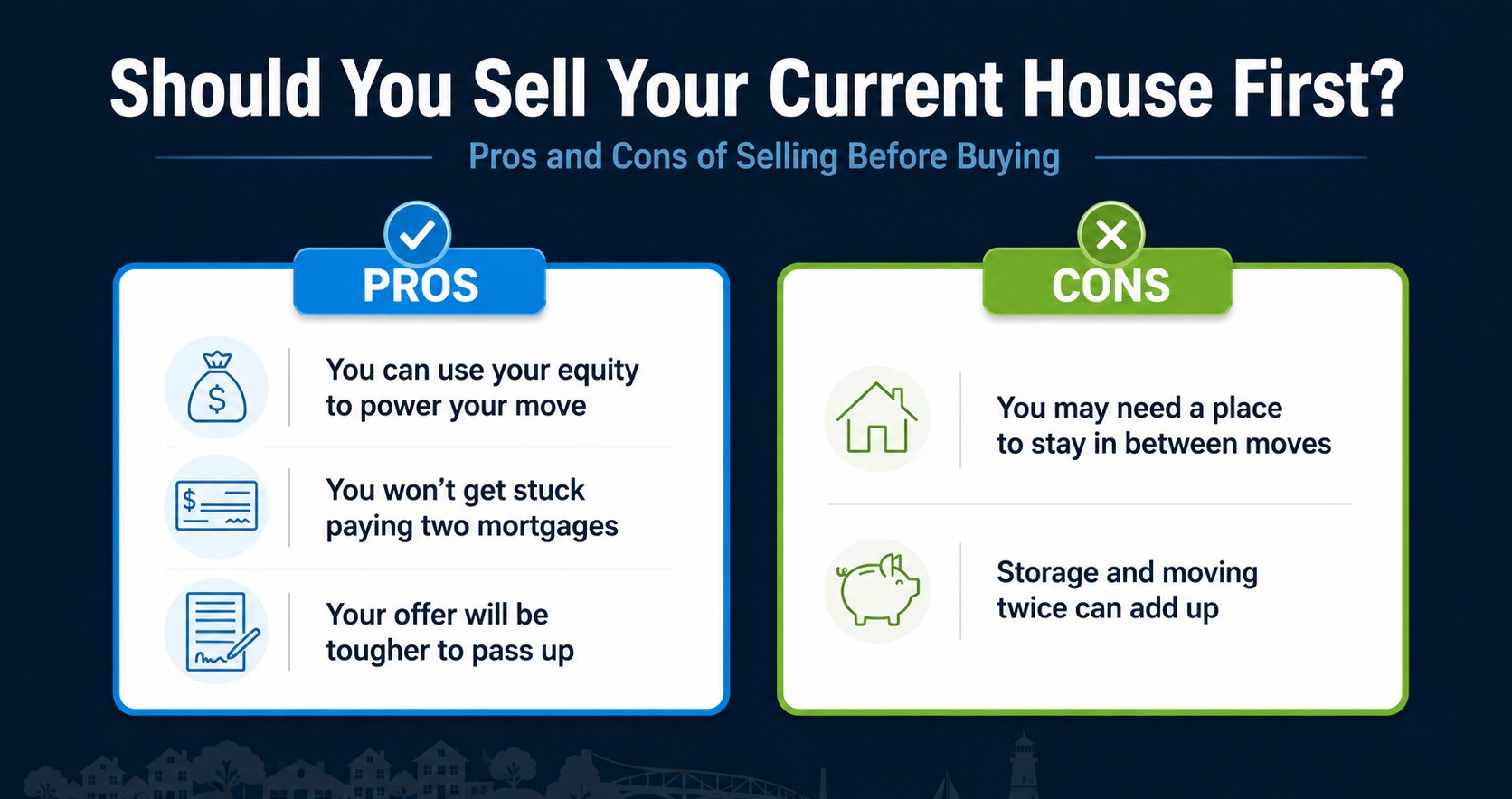
The Pros and Cons of Selling Your Current Home First
Selling first can give you more financial certainty and strengthen your position as a buyer, but there are tradeoffs to consider.
The Advantages
You can use your equity to power your next move.
For many homeowners, the equity in their current property is one of their largest financial assets.
Your home equity is essentially the difference between what your home is worth and what you still owe on it.
Once your home sells, those proceeds can potentially be used toward:
- A larger down payment
- Closing costs
- Paying down other debt
- Renovations or improvements
- Reducing the amount you need to finance
- In some cases, purchasing the next home with substantially more cash
Selling first also removes much of the guesswork. Instead of estimating what your home might sell for, you’ll know your actual net proceeds before committing to the next purchase.
You reduce the risk of paying two mortgages
Buying before selling can temporarily leave you responsible for two properties.
That may mean:
- Two mortgage payments
- Two sets of utilities
- Two insurance policies
- Property taxes on both homes
- HOA or condominium fees
- Maintenance and repair expenses
If your current home takes longer to sell than expected, those costs can continue adding up.
Selling first removes much of that financial exposure.
Your offer on the next home may be more attractive
There is another important advantage homeowners sometimes overlook: your next offer may be stronger.
If you have to sell your current home before completing your purchase, your offer may need to include a home-sale contingency.
From a seller’s perspective, that creates another moving part in the transaction.
If your current home has already sold, or your sale is firmly under contract, you may be able to submit a cleaner offer with fewer contingencies.
That can make a meaningful difference when a seller is deciding between multiple buyers.
Price matters, but so does certainty.
A seller may prefer an offer that appears more likely to reach settlement without complications.
The Tradeoffs of Selling First
Selling before buying can create its own challenges, especially if the timing of the two transactions doesn’t line up perfectly.
You may need somewhere to live between homes
If your current home sells before you purchase your next one, there could be a gap between settlements.
That may mean:
- Staying with family or friends
- Using short-term housing
- Renting temporarily
- Negotiating additional time in your current home after settlement
For some homeowners, that inconvenience is worth the financial flexibility that comes with selling first.
For others, avoiding an interim move may be a major priority.
Storage and moving twice can add up
If you need temporary housing, you may also need temporary storage.
That could mean moving your belongings out of your current home, placing some or all of them into storage, and then moving them again when you purchase your next property.
That adds both cost and inconvenience.
This is one of the reasons the timing strategy should be planned before your home goes on the market.
How Do You Avoid Being Stuck Between Homes?
The good news is that selling first does not necessarily mean you have to move twice or spend months in temporary housing.
There are several ways an experienced real estate agent can help coordinate the transition.
Consider a Post-Settlement Occupancy Agreement
In some situations, you may be able to sell your home and remain in the property for an agreed-upon period after settlement.
This is commonly referred to as a rent-back or post-settlement occupancy agreement.
It can give you additional time to complete the purchase of your next home without having to move immediately after your sale closes.
These agreements need to be carefully structured, and the terms have to work for both the buyer and seller.
Coordinate Settlement Dates
Another option is carefully coordinating the closing dates of both transactions.
For example, your current home could settle first, followed shortly afterward by settlement on your new home.
When the timing lines up properly, the transition can be relatively smooth.
The key is planning the timing before you are deep into both transactions.
Have a Temporary Housing Plan
Sometimes the best strategy is simply giving yourself some breathing room.
That could mean a short-term rental, staying with family, or another temporary arrangement while you search for the right home.
It may not be your first choice, but it can keep you from feeling pressured into buying a property simply because you are facing a deadline.
And that matters.
Buying the wrong house is usually far more expensive than dealing with a short period of temporary housing.
When Buying First May Be the Better Option
Selling first is not automatically the right decision.
There are situations where buying your next home before selling your current one may make more sense.
For example, buying first may be worth considering if:
- You can comfortably carry both properties for a period of time
- You have substantial cash reserves
- Your lender approves you without requiring your current home to sell
- You are searching for a very specific or difficult-to-find property
- Inventory is extremely limited in your target area
- You want to avoid moving twice
- Your current home is expected to generate strong buyer interest
There are also financing strategies that may allow certain homeowners to purchase before selling.
Those options should be discussed with a qualified mortgage professional before you begin making offers.
The Local Market Matters More Than the National Headlines
This is where local market knowledge becomes especially important.
Real estate conditions can vary significantly from one community to another.
What is happening nationally does not necessarily reflect what is happening in Crofton, Odenton, Piney Orchard, Gambrills, Bowie, Annapolis, Severna Park, Severn, Millersville, or other parts of Anne Arundel County and the surrounding area.
Even within the same community, different property types and price ranges can behave very differently.
A $450,000 townhouse may have a completely different buyer pool and market pace than a $900,000 single-family home.
Before deciding whether to sell or buy first, you should understand:
- What your current home could realistically sell for
- How long comparable homes are taking to sell
- Your estimated net proceeds
- How much equity you are likely to have available
- How competitive the market is for the type of home you want to buy
- Whether your next offer may require a home-sale contingency
- How much financial overlap you can comfortably handle
- What options are available to coordinate both transactions
Once you have those answers, the decision becomes much easier.
Start With the Sale Strategy Before You Start Touring Homes
One of the biggest mistakes homeowners can make is falling in love with their next home before they understand what they can realistically do with their current one.
Before spending weekends touring properties, start by determining:
What could my current home sell for, and approximately how much would I walk away with after settlement?
From there, you can build a realistic strategy for both sides of the move.
That does not necessarily mean putting your home on the market immediately.
It means knowing your numbers and having a plan before the right property appears.
Because when the right home does come along, decisions may need to be made quickly.
Bottom Line
Buying and selling a home at the same time requires more coordination than a typical real estate transaction, but it does not have to be overwhelming.
For many homeowners, selling first provides greater financial certainty, reduces the risk of carrying two properties, and may strengthen their position when making an offer on their next home.
For others, buying first provides the flexibility they need to secure the right property before giving up their current one.
The best strategy depends on your finances, your current home’s marketability, the type of home you want to purchase, and your timeline.
If you’re considering a move in Anne Arundel County or the surrounding Maryland area, Scott and the Smolen Team can help you map out both sides of the transaction before you make your first move.
We can look at your home’s potential selling price, estimated equity, current market conditions, and the homes available in your target area so you can determine whether buying first or selling first makes the most sense for you!