


Ten costly mistakes when selling your house, and how to avoid them
Updated Nov 14, 2026 | By Scott Smolen, The Scott Smolen Team at RE/MAX Leading Edge in Crofton, MD, helping buyers and sellers since 1999.

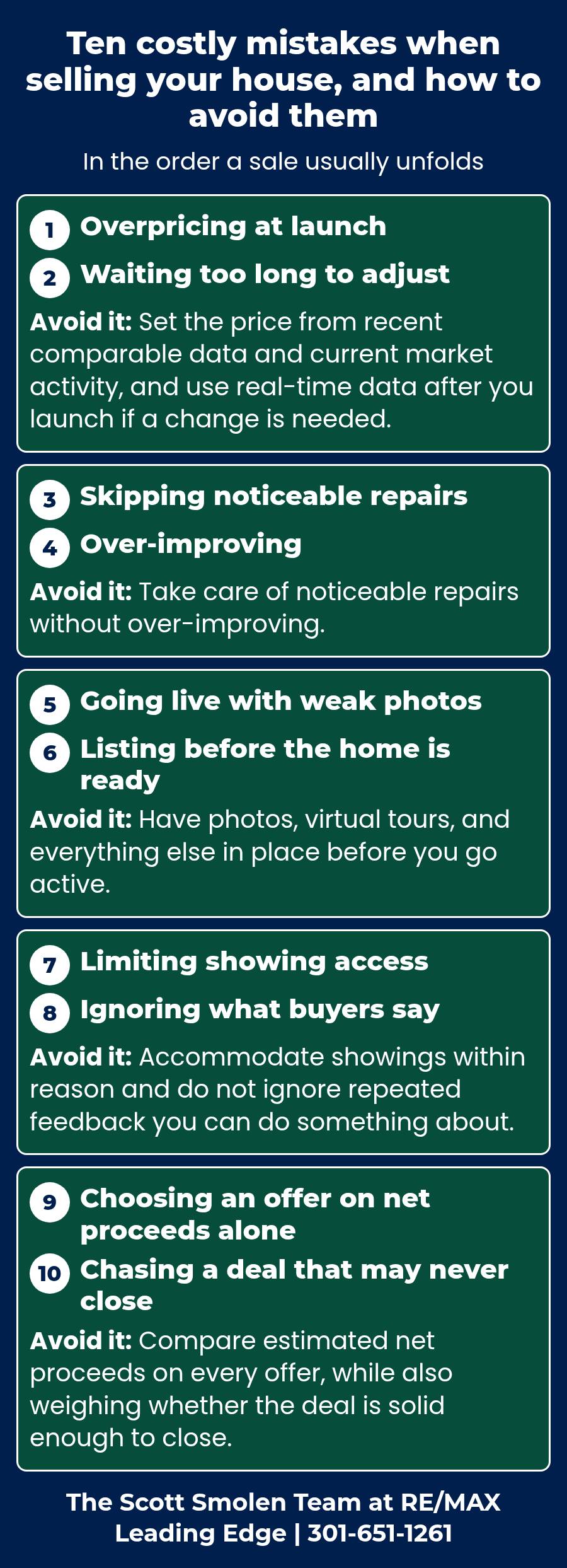
When you sell your house, a few mistakes can cost you time, money, or a solid deal. I have been helping local buyers and sellers since 1999, and these are ten costly mistakes I tell sellers to watch for, along with how to avoid them. In the order a sale usually unfolds, they are: overpricing at launch; waiting too long to adjust; skipping noticeable repairs; over-improving; going live with weak photos; listing before the home is ready; limiting showing access; ignoring what buyers say; choosing an offer on estimated net proceeds alone; and chasing a deal that may never close.
Before you list, it also helps to know what to ask a listing agent. See How Sellers Should Interview a Realtor. For a broader seller checklist, see the Complete Seller Guide and Home Selling Tips.
Overpricing at launch, and waiting too long to adjust
Overpricing at launch, or waiting too long to adjust, can set a sale back before it really gets going.
Mistake 1: Overpricing at launch
Set the asking price using recent comparable data and current market activity. Before you launch, agree with your agent on how you are going to judge the launch, including whether showing activity is something you are going to judge it by.
Mistake 2: Waiting too long to adjust
Some agents believe that you judge a price based on days on the market. That is not necessarily the case. It is sometimes based on days on the market, but a lot of times it is also based on the type of activity and what the feedback is. Then you can adjust the price if necessary, based on what you are seeing in real time.
The market is fluid. It is never the same, so you do not want to go into anything with a hard approach on how things are going to work. You want to make sure that you are using the real-time data that is only collected once your house hits the market, in order to make any changes if any changes need to be made.
Skipping noticeable repairs, and over-improving
Mistake 3: Skipping noticeable repairs
You never want to skip any noticeable repairs with any property that you are selling. If there is anything that is very noticeable and is going to adversely impact your ability to sell, or sell for the maximum value, consider taking care of that before you put the house on the market. Sometimes those things are simple cosmetic adjustments. Other times they may be more involved. You at least want to get a balance, to see what type of investment it would take to eliminate a noticeable repair.
Mistake 4: Over-improving
Spending too much on upgrades is just as much of a problem for some folks. You do not want to over-improve your property and put things into it that are not going to return when you go to sell. That needs to be taken into consideration by the property, the location, and what the comps are. Then you want to make sure that you are not over-improving it, so that you get the maximum return on your investment.
For more on presentation before you list, see Preparing Your Home to Sell.
Going live with weak photos, and listing before the home is ready
Going live with weak photos, and listing before the home is ready, is a major mistake.
Mistake 5: Going live with weak photos
Anytime you put a home on the market without interior photos, buyers automatically assume there is something wrong that you are trying to hide. You want to avoid that at all costs.
Mistake 6: Listing before the home is ready
Make sure that your home is properly photographed, virtual tours are done, and everything is in place before you go active.
If you want a checklist for the photo day itself, see Picture-Perfect: Preparing Your Home for Professional Real Estate Photos.
Limiting showing access, and ignoring what buyers say
Mistake 7: Limiting showing access
Do your best to accommodate all showing requests within reason. If you are living in the home, there are times that you may not be able to accommodate a showing, especially on short notice, or if you are ill, or something along those lines. Anytime you cannot accept a showing and accommodate it, offer back an alternative so that the buyer understands what is happening and they do not think you are just trying to block them from seeing the house.
Mistake 8: Ignoring what buyers say
If any repeated feedback comes up that you can do something about, it is best to discuss it and decide if you want to address it. You cannot change the size of a home. You cannot change the location. You cannot change those types of things. However, you can change things people are continually complaining about, such as an odor or the condition of something else in the house. Those are things that may need to be addressed. Those are things you do not want to ignore.
Choosing an offer on net proceeds alone, and chasing a deal that may never close
Mistake 9: Choosing an offer on net proceeds alone
You want to compare estimated net proceeds on any offer before accepting it. That is a major factor, but it is not the only factor in the strength of an offer.
Mistake 10: Chasing a deal that may never close
If somebody writes an offer with a high offer price, but they have a home they have to sell that is not even on the market yet, that may or may not ever happen. If you are fortunate to have multiple offers at the same time, another offer might be slightly less, but it might be a more solid deal. Sometimes that needs to be factored into the decision you make. You do not want to chase an offer that is not going to come to fruition and end up losing something that is solid.
That is something you should be able to count on your realtor and their experience for: to show you the pros and the cons of the offers. As a seller, you make the final decision. It is up to you. Your realtor should give you advice you can rely on, to say this is the risk, this is the reward, and then you make the decision based on what is in your best interest.
Those ten mistakes can show up at every stage of a sale, from the asking price to the offer you accept. The way to avoid them is straightforward: set the price from recent comparable data and current market activity, and use real-time data after you launch if a change is needed; take care of noticeable repairs without over-improving; have photos, virtual tours, and everything else in place before you go active; accommodate showings within reason and do not ignore repeated feedback you can do something about; and compare estimated net proceeds on every offer, while also weighing whether the deal is solid enough to close.
FAQ
How should I set the asking price when I list? Set the asking price using recent comparable data and current market activity. Before you launch, agree with your agent on how you are going to judge the launch, including whether showing activity is part of that.
Should I judge my price only by days on the market? No. Some agents believe that you judge a price based on days on the market, and that is not necessarily the case. It is sometimes based on days on the market, but a lot of times it is also based on the type of activity and the feedback. The market is fluid, so use the real-time data that is only collected once your house hits the market if a change needs to be made.
Should I fix everything, or can I over-improve before I list? Do not skip noticeable repairs that could adversely impact your ability to sell, or sell for the maximum value. Sometimes those are simple cosmetic adjustments; other times they are more involved. Get a balance of what it would take to eliminate a noticeable repair. Spending too much on upgrades can be just as much of a problem. Do not put money into things that will not return when you sell. Consider the property, the location, and the comps, so you are not over-improving and you get the maximum return on your investment.
When should photos and virtual tours be ready? Before you go active. Make sure the home is properly photographed, virtual tours are done, and everything is in place. If you put a home on the market without interior photos, buyers automatically assume there is something wrong that you are trying to hide. Avoid that at all costs.
What if I cannot accommodate a showing, or I keep hearing the same feedback? Do your best to accommodate showing requests within reason. If you cannot, offer an alternative so the buyer does not think you are trying to block them. If repeated feedback comes up that you can do something about, such as an odor or a condition issue, discuss it and decide whether to address it. You cannot change the size or the location of the home.
Is the highest offer the one I should take? Not always. Compare estimated net proceeds on any offer before you accept it. That is a major factor, but it is not the only factor in the strength of an offer. A high offer that depends on the buyer selling a home that is not even on the market yet may or may not ever happen. If you have more than one offer, a slightly lower one might be a more solid deal. You do not want to chase an offer that will not come to fruition and lose something that is solid. Your realtor should lay out the pros and cons, the risk and the reward. You make the final decision, based on what is in your best interest.